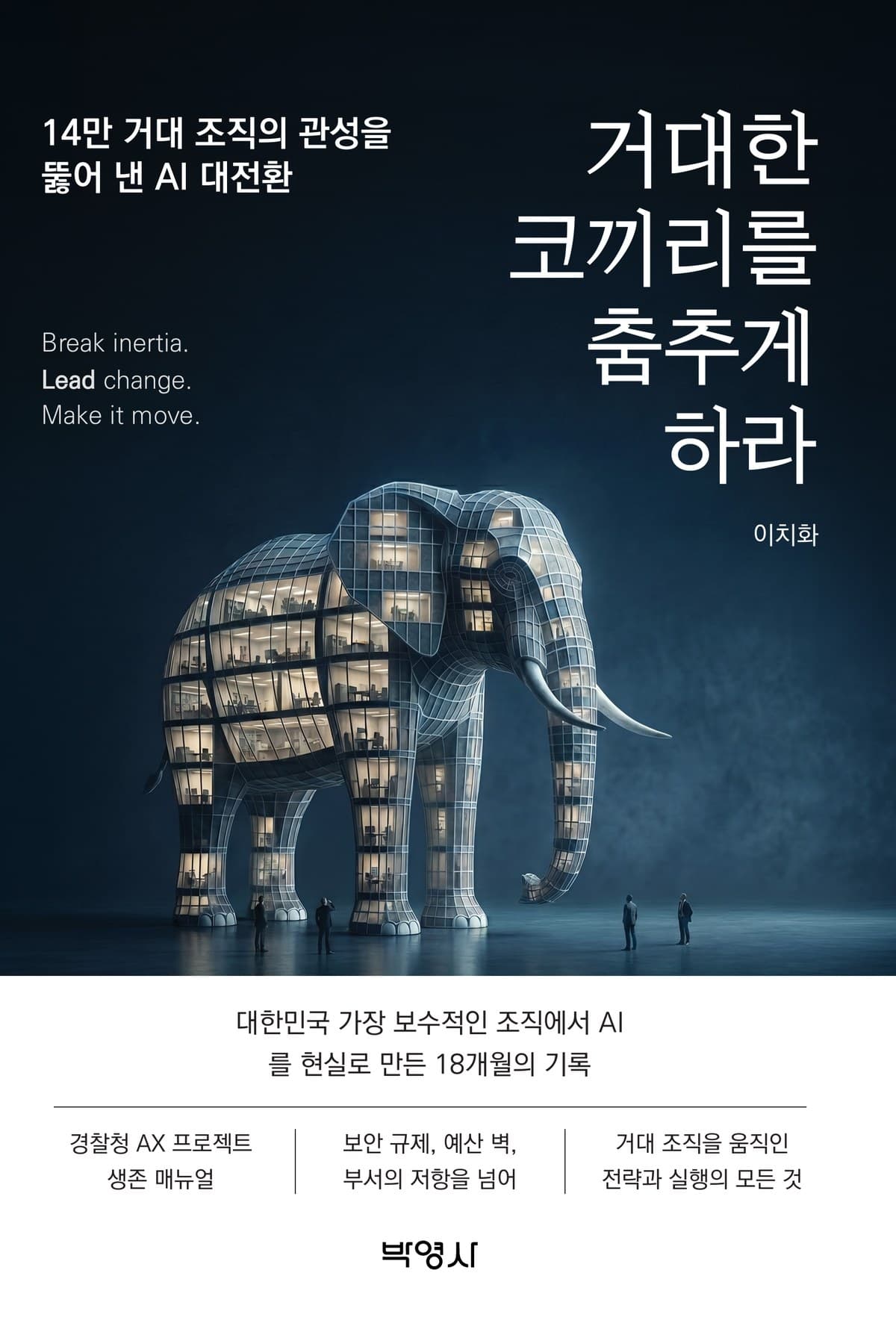
거대한 코끼리를 춤추게 하라
A field casebook on the eighteen months in which Korea's National Police Agency — 140,000 people — decided how it would adopt AI.
- Author
- Chihwa Lee · 이치화
- Publisher
- Parkyoung Publishing (박영사)
- Published
- August 2026
- Language
- Korean
Make the Giant Elephant Dance
How a 140,000-person public organization broke its own inertia and took on AI
14만 거대 조직의 관성을 뚫어 낸 AI 대전환
This is not a success story and not a memoir. It reconstructs seventeen decision points that a 140,000-person public organization passed through between November 2024 and April 2026: which decisions worked, which failed, and what organizational mechanism was moving underneath each one.
The through-line is that most AI adoption in large organizations does not fail on technology. It fails on the organization's immune response — and that response is better treated as healthy inertia to be negotiated with than as resistance to be overridden.
Written from inside the institution, by the officer who now designs its AI policy. The book is aimed at executives, CDOs, and middle managers in organizations large enough to have an immune system of their own.
- Organization
- 140,000 people
- Period covered
- Nov 2024 – Apr 2026
- Decision points
- 17
- Operating principles
- 5
Five operating principles
Adoption fails on the immune response, not the technology
Treat resistance as healthy inertia with a reason behind it, and negotiate with it rather than trying to overpower it.
When ROI cannot be proven, reframe to COI
The cost of inaction is often the only honest number available early, and it is the one that survives budget review.
Start at the front office, not the core
The first deployment should be where a mistake is recoverable and the benefit is visible to the people doing the work.
Preserve tacit expertise as a digital twin
A retiring veteran's judgment does not survive in a document. It has to be captured as something a system can actually run against.
The last one percent belongs to a human
Where AI cannot carry accountability, the design has to hand the decision back — explicitly, not by default.
Contents
Prologue, five parts across eighteen chapters, epilogue, and four appendices.
The operating environment of public-sector AX
공공 AX의 작동 환경 — 규제·예산·법령이라는 삼중 자물쇠
Why private-sector DX playbooks do not transfer · why data silos hold · what a lost ₩10B competition taught · how other countries are doing it · AI as a weapon, and as a shield
The organizational immune mechanism
조직 AX의 면역 메커니즘 — 저항을 '건강한 관성'으로 재해석하다
Why 140,000 people refuse a new tool · the black box and the role of the explainer · displacement versus returning people to the work · the science of upskilling
The blind spots of data
데이터의 사각지대 — 알고리즘이 놓치는 영역과 인간 판단의 보완 함수
When clean data lies · who is accountable when the model is wrong · why models are confidently wrong
Turning tacit knowledge into an asset
암묵지 자산화 — 베테랑의 직관을 시스템에 이식하는 설계
Veteran retirement as a loss of organizational immunity · building a digital twin of field intuition
The adoption roadmap
도입 로드맵 — 프론트오피스 우선·통합·분산 추론
Why not the core first · loose-coupling architecture for fragmented systems · edge and distributed inference under a split budget · a 100-day playbook, week 1 to week 14
- A — Operating principles, practical checklists, and a role × AI matrix
- B — The practitioner's toolkit
- C — Five- and ten-year scenarios for Korean public AI, mapped with Dator's four archetypes
- D — References and index